



Teaching is one of the most meaningful professions in the world. It is also one of the most exhausting.
Behind every lesson plan and parent email is a teacher carrying a workload that rarely ends. And today, burnout is no longer a quiet staffroom concern, it is a systemic crisis.
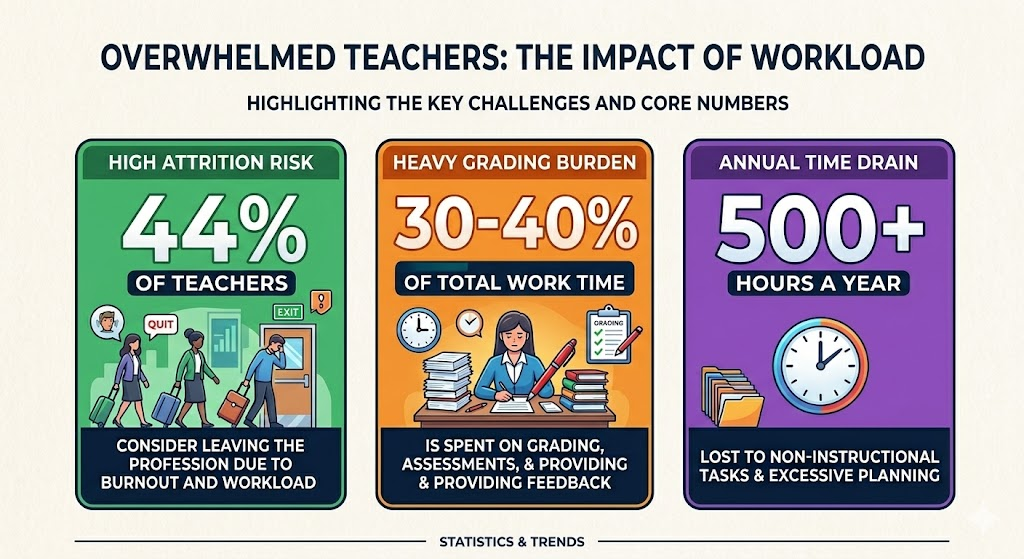
Nearly 44% of teachers consider leaving within their first five years. Class sizes are increasing. Administrative demands are multiplying. And the marking pile never disappears.
When teachers burn out, students lose experienced educators. Schools struggle with retention. And the teachers who remain have less time to actually teach.
Burnout is not inevitable, but it is predictable. Understanding where it comes from is the first step toward helping teachers overcome teacher burnout for good.
What Is Teacher Burnout?
Teacher burnout is chronic physical and emotional exhaustion caused by sustained, unmanageable workload.
It is not end-of-term tiredness. It is a deep depletion that changes how teachers feel about their work, their students, and their purpose.
Most importantly: burnout is not a personal failure. It is a structural one.
When teachers spend 30–40% of their working hours on grading alone, that is not poor time management. It is a system problem.
For a teacher managing 150+ students, grading can exceed 500 hours a year. Those hours come from evenings, weekends, and holidays — slowly eroding recovery time and long-term sustainability.
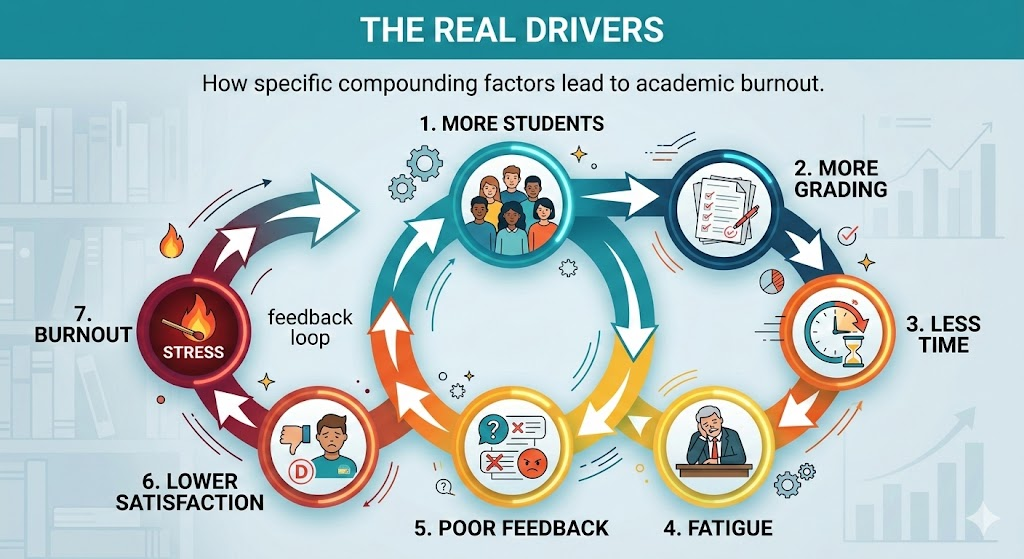
The Real Drivers of Teacher Burnout
1. The Grading Burden
Grading is relentless, essays, assignments, tests, projects. The backlog never ends.
Research shows grading quality drops significantly after 20–30 papers due to fatigue. The 100th script never receives the same attention as the first.
This is not just a wellbeing issue. It is an equity issue.
2. Inconsistency and Fairness Pressure
Human grading is inherently inconsistent. The same paper graded by different teachers can vary significantly in score.
Teachers care deeply about fairness, but volume, fatigue, and time pressure make consistency difficult. When marks are challenged, the stress compounds.
3. The Feedback Gap
Students want meaningful feedback, but when a teacher is responsible for hundreds of submissions, personalised comments become impossible at scale.
Assessment becomes a number, not a conversation.
And when teachers cannot give the feedback they know students deserve, job satisfaction declines.
And when teachers cannot give the feedback they know students deserve, job satisfaction declines.
4. Expanding Expectations
Growing class sizes. Increased documentation. Audit-ready assessments. Outcome tracking.
Modern teaching requires not only delivering quality education, but constantly proving it.
The maths simply does not add up.
Signs of Teacher Burnout
Burnout builds gradually. Early recognition matters.
Emotional signs
- Dread at the start of the week
- Emotional detachment from students
- Growing cynicism
- Loss of satisfaction
Physical signs
- Chronic fatigue
- Frequent illness
- Sleep disruption
Behavioural signs
- Procrastinating grading
- Working late out of obligation
- Withdrawing from colleagues
If several of these feel familiar, it is not something to dismiss.
How Schools Can Reduce Teacher Burnout
Addressing burnout requires both personal boundaries and systemic change. Schools that act now give their teachers a real path to overcome teacher burnout, rather than manage it indefinitely.
1. Reduce the Grading Load
Because grading is one of the primary burnout drivers, reducing it creates immediate impact.
This is where DeepGrade by Smartail makes a measurable difference.
DeepGrade uses AI-powered assessment to:
- Evaluate papers in hours, not days
- Apply consistent rubric standards across every submission
- Generate structured, meaningful feedback at scale
Teachers regain evenings. Schools improve consistency. Students receive timely feedback.
Most importantly, teachers return their energy to teaching.
2. Protect Work-Life Boundaries
Set defined grading windows. Protect at least one work-free day per weekend. Recovery is not optional, it is professional sustainability.
3. Build Peer Support
Burnout worsens in isolation. Regular check-ins and honest conversations within schools reduce emotional strain and normalise support.
4. Invest in Systems – Not Just Advice
Burnout cannot be solved by asking teachers to “manage stress better.” It requires structural solutions that reduce workload, not add to it.
Schools that invest in workload-reducing tools retain stronger educators and deliver higher-quality learning.
A Sustainable Future for Teaching
Teacher burnout is not mysterious. It is the predictable outcome of excessive grading, expanding expectations, and insufficient support.
The teachers leaving the profession are not failing.
The system is.
At Smartail, we built DeepGrade because teachers deserve better tools, and more time.
AI-powered grading that is fast, consistent, and scalable allows teachers to focus on what matters most: teaching, mentoring, and connection.
Burnout is real. But it is solvable.